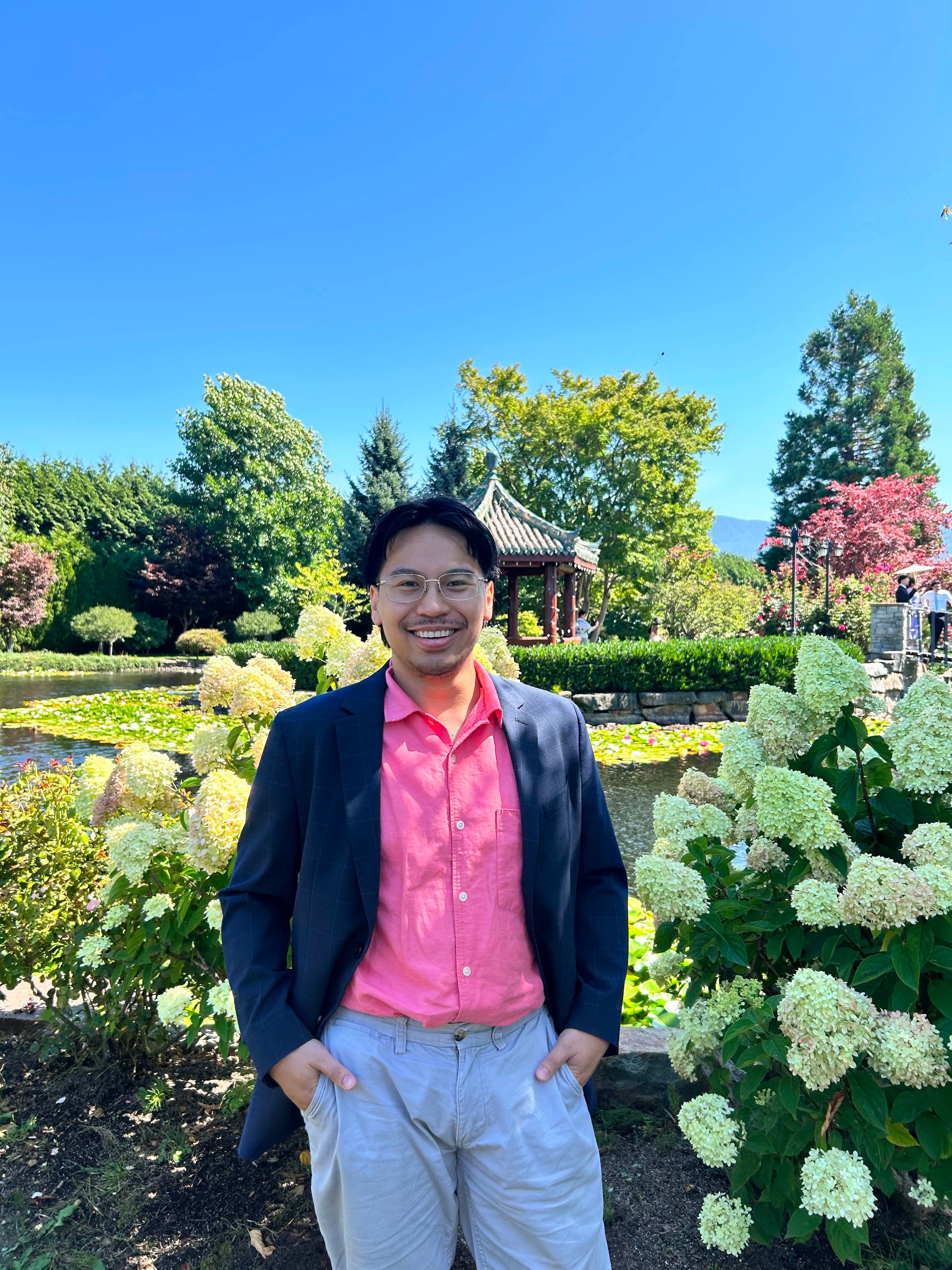
I am currently in my third year of completing my bachelor's degree in Electrical Engineering with a minor in Digital Engineering at University of Calgary. My pursuit in Electrical Engineering stems from my interest in technology and how it is integrated in almost every aspect of modern society. It motivates me to think that technology continues to evolve and advance in ways that can drastically change the world. I want to be able to contribute to the evolution and advancement in technology that will help bring solutions to problems and issues that currently is affecting the world.
Aside from the studies, I enjoy spending time in my extracurricular activities. One of my extracurricular activies is playing soccer at the Calgary Sports & Social Club with a team of 15 people. Our team name is "The Philosophers."
In addition, I enjoy playing the guitar, spending time with friends and family, playing sports and videogames, taking strolls around the city, reading and journaling, learning languages, and travelling to other countries.
As an Electrical Engineering student, I am given opportunities to learn the theories and fundamentals in software, hardware, and firmware. In addition, I am familiar with the concepts in mathematics and physics to use as tools in designing and analyzing circuit behaviour.
Course Concepts
In mathematics, I am familiar with the concepts in linear algebra, calculus, multi-variable calculus, vector calculus, differential calculus, Fourier and Laplace domains, and probability and random variables.
In physics, I am familiar with the concepts in electricity and magnetism, acoustics, and quantum mechanics.
Software Concepts
I am eager to apply and further enhance my skills in software, including but not limited to, artificial intelligence and machine learning (Python - Scikit-learn and Fastai), app development (Android Studio - Kotlin), web development (HTML and CSS), embedded systems (Raspberry Pi, MPLAB Microcontroller, VHDL - ModelSim FPGA), AutoCad (Fusion 360), and other languages such as C, Processing, MATLAB, and Arduino.
Hardware Concepts
In addition, I am also eager to apply the theories and principles I acquired in my studies ranging from logic gates and Karnaugh maps to Computer Microarchitecture; from signal analysis to operational amplifiers (Opamp) and filter and controller design; from BJT and MOSFET transistor design and analysis to amplifiers and circuit design and analysis. Lastly, I am also familiar with transformer and transmission line design and analysis.
Digital Engineering is my minor at University of Calgary. Digital Engineering involves applying the language Python to explore concepts in web servers (Flask, HTML, CSS, Javascript), graphical user interfaces (G.U.I - Tkinter), command line interfaces (C.L.I), programming methods (Hash functions, Recursion, Depth-first search, and Backtracking), and machine learning (Scikit-learn and Fastai).
Furthermore, my minor explores the methods of training machine learning models. The general idea is to prepare the dataset, initialize the dataloaders, define the neural network, create the learner, and call fit to train the model. However, there are certain considerations at each step.
Considerations:
What is the type of learning: regression, classification, clustering? What is the size of the dataset? What are the sizes of the training and validation datasets? What are the augmentations needed on the dataset? What is the size of the architecture and how many layers? What is the learning rate to be used to train? How many epochs to train? Is the model overfitting? What is the accuracy and the loss of the model performance? Is the confusion matrix optimal?